Google Ads Budget Discipline for Founder-Led Companies
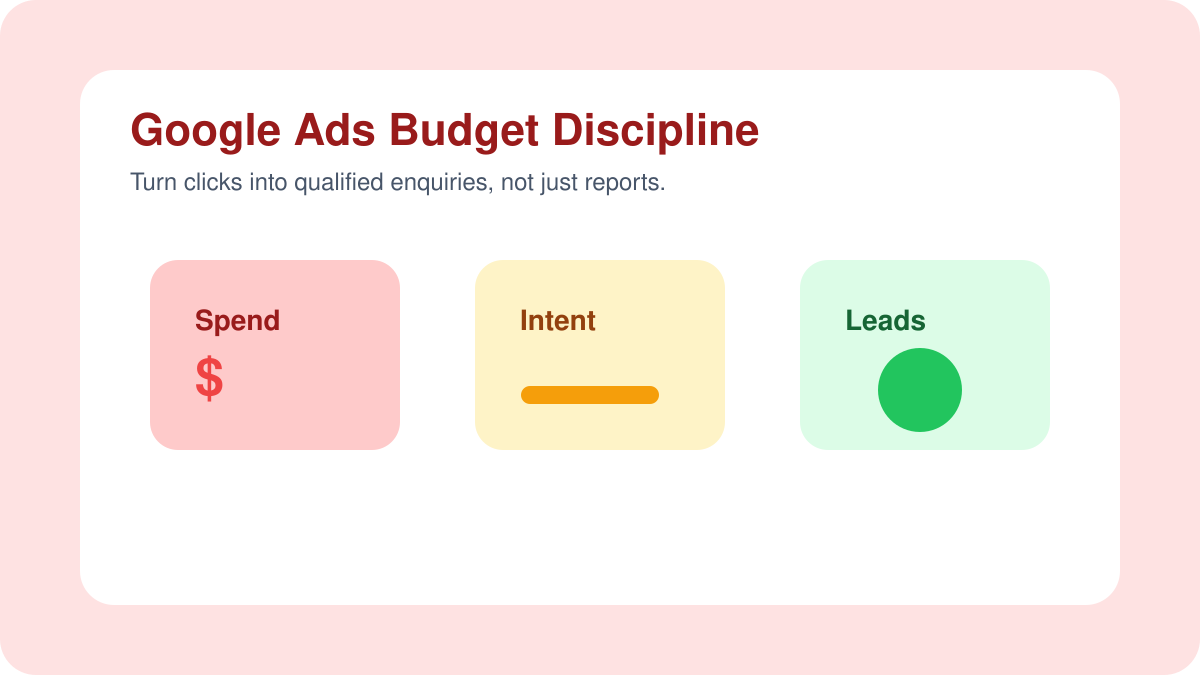
Google Ads can be useful for a founder-led company because it puts the business in front of people who are already searching. It can also waste money quickly when the account is built around clicks rather than commercial intent. A small business does not have unlimited budget for broad experiments. It needs budget discipline: clear goals, specific landing pages, strong qualification, reliable tracking and a review rhythm that connects spend to real opportunities.
Start with the job the campaign must do
Before choosing keywords or writing ads, decide what job the campaign must do. Is the business trying to generate phone calls for a local service? Book consultations for a high-value offer? Test demand for a new service? Support a seasonal push? Replace weak referral flow? Each goal changes the campaign structure. A campaign designed for urgent local calls should not look the same as a campaign designed for SaaS demo requests or consulting enquiries.
The goal should include a quality standard. More leads is not enough. The business needs leads that match the service, location, budget, urgency and delivery capacity. Without a quality standard, the account may optimize toward cheap conversions that waste sales time. Budget discipline begins by defining what a qualified enquiry actually means.
Use landing pages that match intent
Many ad campaigns send traffic to a generic home page. That can work when the home page is clear and the search intent is broad, but it often weakens conversion. A person searching for a specific service wants immediate confirmation that the business understands the problem. The landing page should match the ad promise, explain the service, show trust signals, answer common objections and make contact easy. If the visitor has to hunt through menus, the budget is paying for confusion.
- Match the query: the page should clearly reflect what the person searched for.
- Explain the offer: the visitor should understand what happens after contact.
- Show trust: use proof, process, reviews or useful explanations.
- Keep action visible: contact paths should stay easy to find on long pages.
For SEO and paid search, long-form content can be helpful when it is structured. Headings, subheadings, lists, visual diagrams and clear CTAs keep the reader oriented. Sticky navigation helps users move to Blog, About or Contact without getting lost in heavy blocks of text. This matters because paid visitors are impatient. They need to know they are in the right place quickly.
Protect the budget with campaign boundaries
Campaign boundaries prevent waste. Choose locations carefully. Use negative keywords. Separate brand, service, competitor and research intent where useful. Avoid mixing very different services in one campaign if they have different economics. Set budgets according to learning goals and cash tolerance. A founder should know how much can be spent before the campaign must show useful evidence.
Useful evidence is not always immediate profit. Early evidence may include search term quality, landing page engagement, form quality, call quality or discovery of a better buyer segment. But the founder should define the learning target before spending. Otherwise every result can be explained after the fact, and the budget becomes harder to control.
Track qualified leads, not just conversions
Conversion tracking is essential, but it can be misleading if every form submission is treated equally. A spam form, wrong-location enquiry, tiny project and high-value opportunity may all count as conversions. The founder needs a way to mark qualified leads. This can be done in a CRM, spreadsheet or simple review log at first. The important thing is to connect the ad source to the quality of the conversation.
Call tracking deserves the same discipline. Calls can look successful in reporting while many are irrelevant. A service business may receive calls from job seekers, suppliers, existing customers or people outside the service area. Review call quality, not only call count. If a campaign produces a high volume of poor calls, the keywords, ad copy, listing information or landing page may be too broad.
Review search terms with commercial judgment
Search term review is one of the most practical habits in paid search. It shows what people actually typed before clicking. Some terms reveal strong buying intent. Others reveal research, price shopping, DIY intent or a mismatch. A founder or manager who understands the business should review these terms regularly, not leave the task entirely to software. The account needs human commercial judgment.
When reviewing search terms, ask whether the person behind the search could become a profitable customer. Would the business want this enquiry? Does the landing page answer the likely question? Should the term be added, excluded or placed in a separate campaign? Over time, this habit improves both budget efficiency and page strategy. It can reveal content topics for organic search as well.
Connect ads to finance
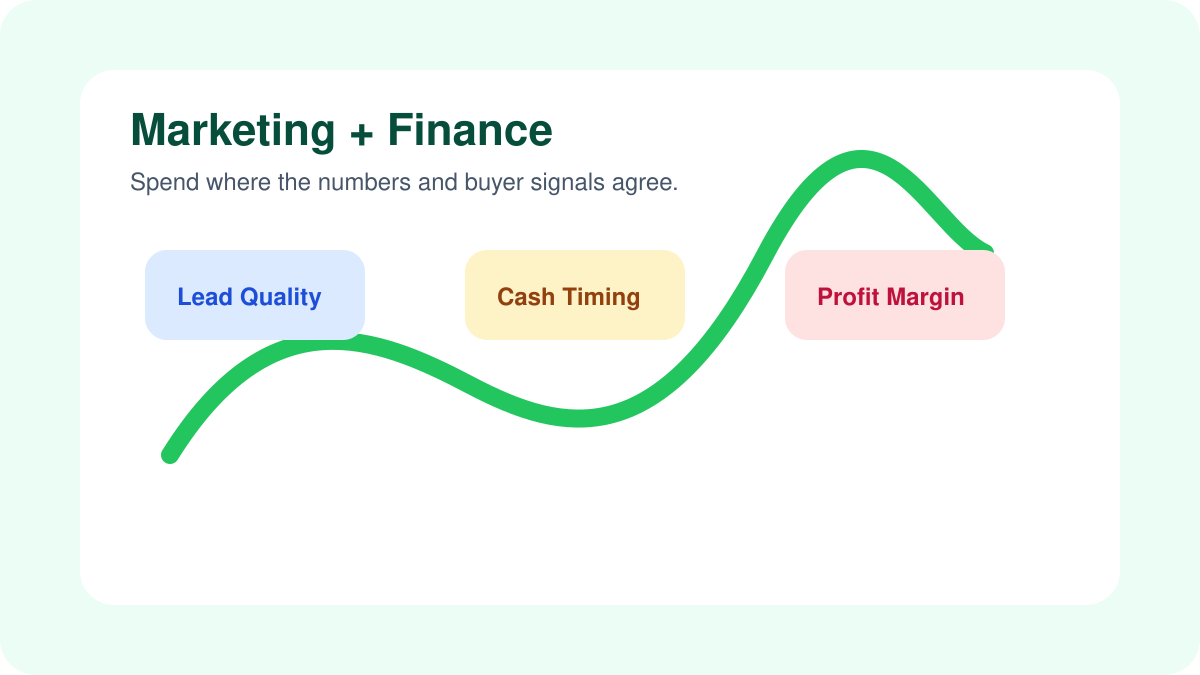
Paid search should be reviewed with financial context. A cost per lead may look high until the business considers deal value and margin. A cheap lead may be expensive if it never converts or creates low-margin work. The right number depends on the offer. Founders should define acceptable cost per qualified lead, target conversion rate, expected value and follow-up requirements. This keeps ads from becoming either reckless or overly cautious.
The goal is not to make every campaign perfect immediately. The goal is to create a learning system. Spend where search intent, landing page quality and commercial value align. Pause or repair campaigns that create noise. Improve tracking. Tighten the offer. Use budget as a tool for disciplined learning. That is how Google Ads can support growth without taking control of the business.
A founder-friendly review checklist
A founder does not need to inspect every setting to stay in control of paid search. A short review checklist is enough to ask better questions. Which search terms spent the most money? Which terms created qualified calls or forms? Which locations produced useful enquiries? Which ads promised something the landing page did not explain? Which landing pages had traffic but weak contact rates? Which leads became real sales conversations? These questions make the account commercially accountable.
The review should also identify what not to change. New campaigns need enough data to learn, and constant tinkering can make results harder to read. Budget discipline does not mean panic. It means knowing the test, the limit and the decision date. A founder can allow a campaign to run while still protecting the business from uncontrolled spend.
Paid search works best when it is connected to the rest of the growth system. The service page must be clear. The contact form must work. The phone must be answered. The CRM must record source and quality. Finance must know whether the acquired work is worth the cost. When those pieces are connected, Google Ads becomes one useful channel rather than an expensive mystery.
Keep the first test narrow
If a business is unsure where to begin, the first test should be narrow. Choose one service, one location or one buyer problem. Build a landing page that answers that intent clearly. Set a budget the business can afford to learn from. Review search terms, calls, forms and sales notes before expanding. A narrow test creates better evidence than a broad campaign that mixes too many assumptions.
This is how paid search becomes safer for founder-led companies. The campaign is not judged by hope or fear. It is judged by whether the test produced useful signals about demand, offer fit, landing page quality and follow-up.