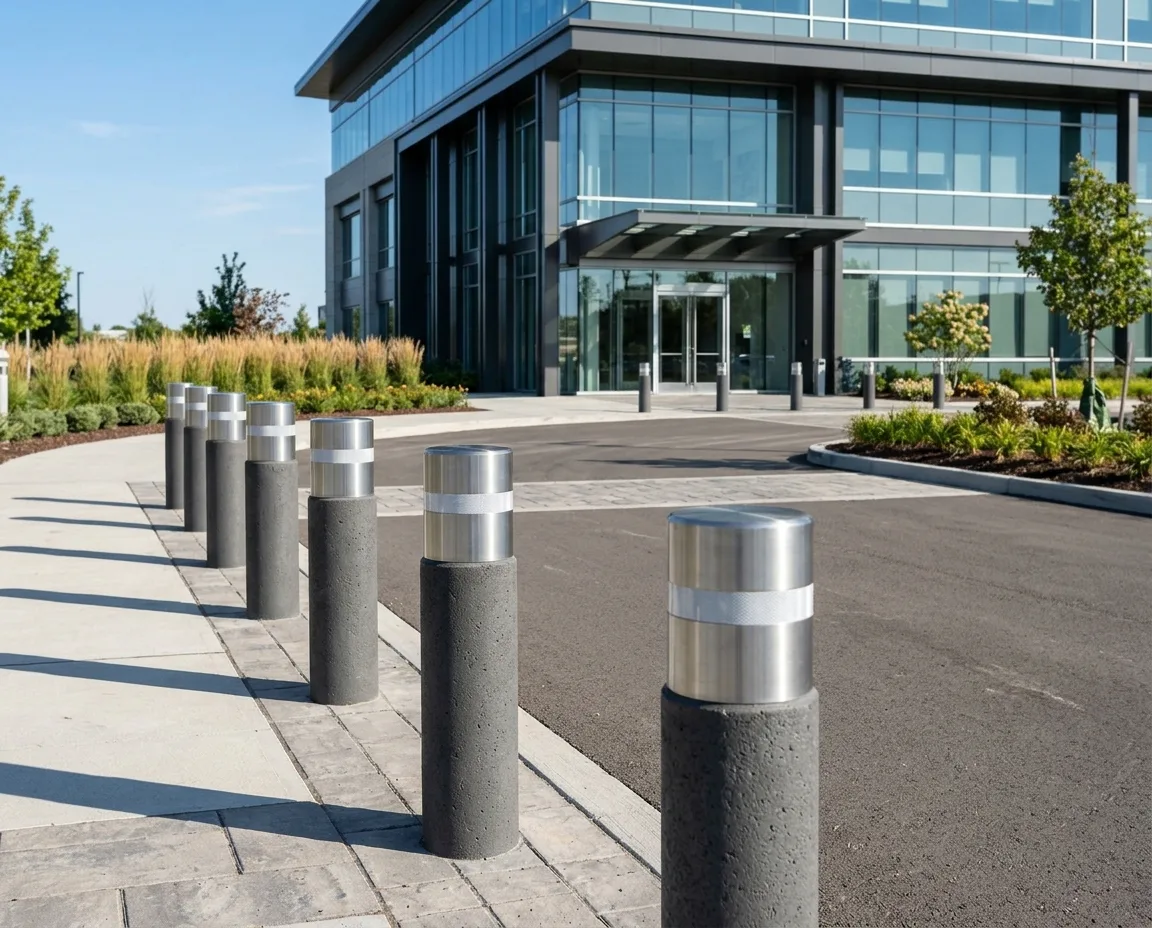
1-800 Bollards offers architectural and security bollards online, with a “Buy Now” inventory for customers who need to source a product. You can browse product pages and check the in-stock inventory to find options for a vehicle, parking area, facility, or property.
Before ordering, match the post to the site’s access needs, protection goal, and installation conditions. Those details affect which product fits and whether the planned location can support its installation.
Key Takeaways
- Start with the protection goal and the vehicle paths at the site.
- Choose a post style that suits how often access must change.
- Match the mounting method to the existing surface or ground conditions.
- Check product dimensions and installation details before ordering.
- Use the in-stock inventory to review items listed as available.
Start with the location’s protection needs and access requirements before choosing a post.
Buy Safety Bollards for Your Site
A bollard barrier is most useful where vehicles and people need clearly separated paths. It creates a visible boundary that can guide vehicle movement and help protect pedestrians, entrances, and sensitive building features.
Common settings include streets, construction sites, parking lots, and building fronts. A bollard can mark where vehicle traffic should stop or change direction, while helping people see the edge of a protected area.
Safety Bollard Barriers for Vehicles and Pedestrians
Use a barrier to make a vehicle boundary easier to see, especially where people walk close to traffic. The right placement depends on the vehicle path and the area pedestrians need to keep clear.
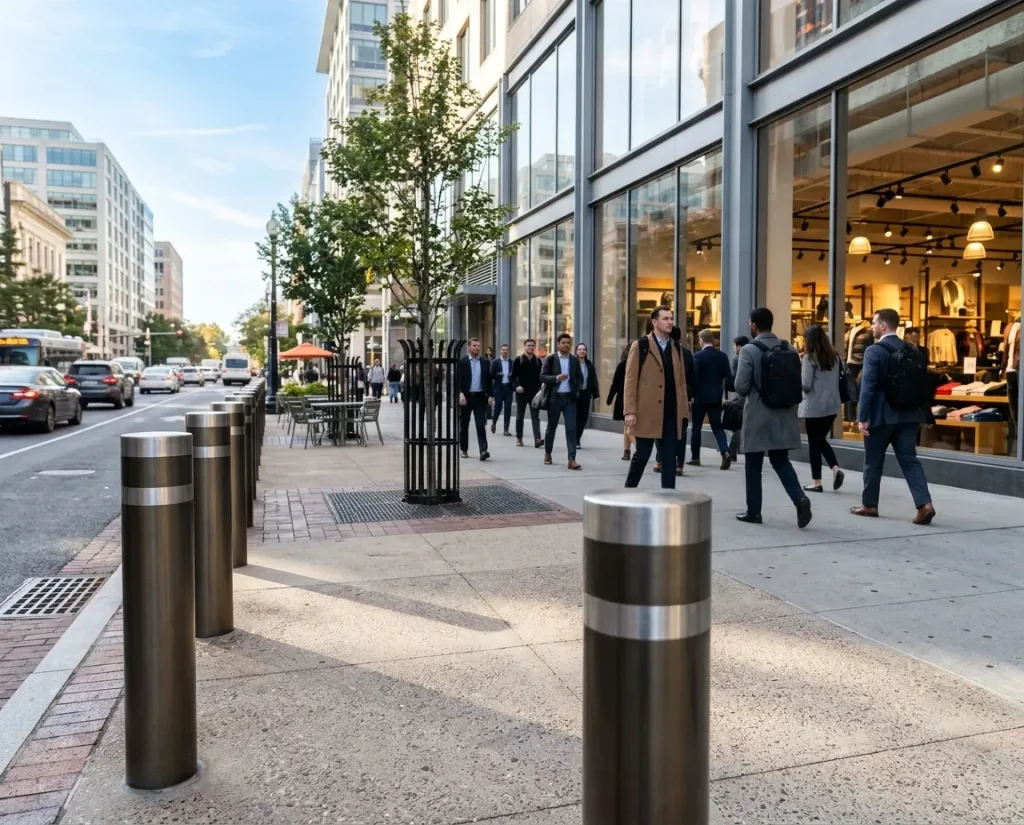
- Storefronts, where a vehicle could approach the building front.
- Parking areas, where posts can help define vehicle movement.
- Pedestrian routes, where people need a clear path away from vehicles.
- Construction or work zones, where traffic needs a visible boundary.
Bollards, bollard posts, and other barriers can help organize access, but visibility alone does not make a system impact-rated. If the project requires impact resistance, select an engineered crash-rated system for that purpose.
Match Protection to the Location
Think about what needs protection at the exact point where a vehicle might leave its normal path. A building entrance, outdoor seating area, or walkway may need a different layout from an open parking aisle.
Mark the vehicle approach and the pedestrian route on a site plan before deciding how many posts to place. That simple sketch can show where a visible boundary helps and where it could obstruct the route people need.
Choose Fixed, Removable, or Retractable Bollards
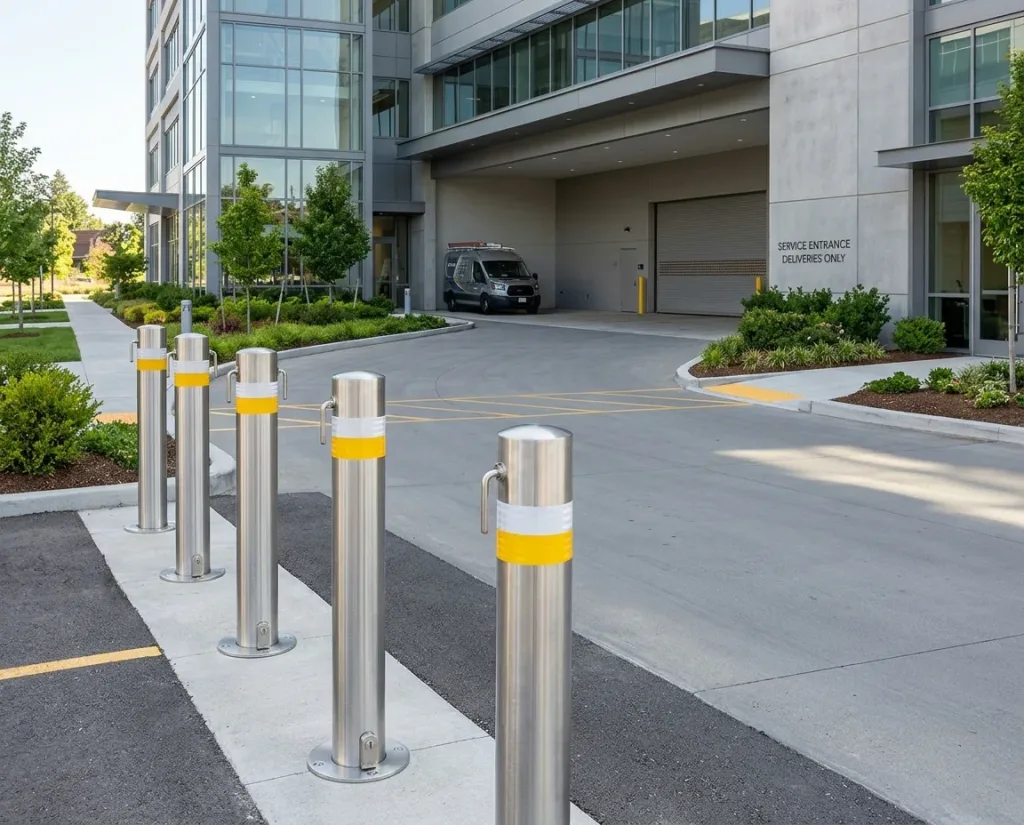
A fixed post suits a boundary that should stay closed, while a removable or retractable style makes planned vehicle access possible. Choose based on whether the entrance must remain blocked or open for certain vehicles.
A removable bollard is a bollard designed to be taken out of or lowered into its base so vehicle access can change. Product types include fixed or stationary, removable, and retractable designs.
A Safety Bollard Post for a Fixed Boundary
A fixed safety bollard post is the straightforward choice for a boundary that does not need to open. Once installed, it stays in place to mark the vehicle limit at an entrance or along a protected area.
This style suits locations where the access plan is stable. It avoids an operating routine for opening the boundary, which can make day-to-day use simpler for staff and visitors.
Removable Bollards for Changing Access
Removable bollards suit entrances that need occasional vehicle access, such as a service route used only at certain times. A removable unit may use a base, receiver, folding mechanism, or locking feature, depending on the model.
Retractable bollards also allow vehicle access to change, but the post lowers into the ground or its housing rather than being lifted out. Check how a model locks and how its base or receiver is installed before choosing it.
Confirm who will operate a locking or removable unit and how often the access point needs to open. A clear operating plan helps prevent an open entrance from being left unattended.
Select a Mounting Method for the Site
The mounting method should match the surface you have and the amount of excavation the site can accommodate. A surface-mounted post attaches to an existing hard surface, while an in-ground post or receiver sits below grade.
Surface-mounted bollards typically use a bolted plate and anchors, and they often avoid excavation. Embedded installation takes more site work because the post or receiver must be set below the surface.
Surface-Mounted Bollards on Existing Hardscape
A surface-mounted system needs a suitable hard surface and correctly installed anchors. The mounting plate secures the post to that surface, so the surface must support the anchor layout and loads expected for the application.
Do not choose a surface mount before checking the condition and thickness of the existing surface. A slab that is cracked, too thin, or otherwise unsuitable may not hold the required anchors as intended.
In-Ground and Pour-in-Place Installation
In-ground bollards have a post or receiver installed below grade. This method requires excavation and coordination with the footing, so utilities and other site features matter before work begins.
Pour-in-place safety bollards are set in concrete to create a permanent installation. The post is placed as concrete is poured, rather than being secured to the top of an existing surface with a plate.
Confirm what lies beneath the proposed mounting location before drilling or excavating. That check can help identify buried utilities or other features that affect the work.
Compare Steel, Stainless Steel, and Bollard Covers
Choose the post material for the site’s duty, then treat the cover as a separate finish decision. Steel is a common choice for security and traffic-control posts, while stainless steel may suit a location where appearance matters.
The structural post provides the installed barrier. A cover fits over an existing post or core, giving you a separate way to manage the visible finish without replacing that post.
Steel Pipe Posts and Protective Finishes
A steel bollard can serve a security or traffic-control role, with a finish selected for the site’s conditions and appearance. Steel pipe posts are available in different product designs, so review the specific model rather than assuming every post has the same construction.
Stainless steel can be a suitable choice at a finish-sensitive entrance or other visible area. Consider how the post will look alongside nearby building features and how much surface upkeep the location can accommodate.
Covers for Appearance and Maintenance
Bollard covers can refresh a worn appearance and reduce repainting or other surface-maintenance work. A cover is a finish feature, not a way to increase a post’s vehicle-impact resistance.
Type 304 stainless steel is one material option for stainless steel bollard covers. Covers may also come in other finishes, so compare the available product details with the look you want at the site.
Check the cover’s fit against the installed post’s outside dimensions and shape. Verify that the cover fits the installed post rather than assuming a similar-looking model will fit.
Size Bollard Posts for the Location
Bollard dimensions should fit the vehicle path and the space people need to use, not just the open area on a drawing. Typical diameters range from 3 to 12 inches, and product heights vary by model and purpose.
Check the finished dimensions against the site plan and the product drawings. A safety bollard post is a dimension-and-fit decision as well as a barrier, especially beside parking spaces, doors, and pedestrian routes.
- Available clearance around the proposed post location.
- Vehicle approach, including the direction vehicles travel.
- Visibility needs for drivers and people on foot.
- The post’s intended protection role at that specific point.
Diameter and height affect how a post fits within the site layout. A larger post may occupy more space near a parking stall, while a shorter post may be less visible from a vehicle.
Use the product drawings to compare the listed dimensions with door swings, curbs, and nearby equipment. Check how the post sits relative to the route people must use, not just its footprint on the plan.
A cover can change the finished outside dimension and affect clearance around the post. Include it in the layout if the selected product will use a cover.
Check finished dimensions, including any cover, against nearby doors, curbs, and accessible routes.
Plan Installation Depth Around Soil and Frost
For non-rated bollards, typical foundation depth ranges from 18 to 36 inches depending on the use. Site conditions matter: soil and local frost depth affect how far the concrete foundation should extend.
Use these typical ranges as a starting point for non-impact applications, not as a substitute for checking local requirements. Soil that expands or contracts with moisture can affect how well a shallow foundation stays in place.
| Use | Typical foundation depth | Condition to check |
|---|---|---|
| Decorative non-impact | 18 to 24 inches | Confirm it suits the site |
| Standard non-rated parking lot | 24 to 30 inches | Account for soil |
| Non-rated storefront protection | 30 to 36 inches | Confirm local conditions |
Clay soil can favor the deeper end of a foundation-depth range. Moisture-driven expansion and contraction can dislodge a shallow footing over time.
Foundations should extend below local frost depth. Approximate U.S. frost depths range from 12 inches in the Coast Range to 30 to 36 inches at Cascade summits, but those regional figures do not replace local requirements or site checks.
Check local frost depth and soil conditions before setting the foundation.
Match Crash Ratings to Certified Installation
A crash rating applies only when the bollard is installed in the configuration that was tested. The certified configuration is the vehicle-impact rating and installation tested together, not a rating for a post considered by itself.
ASTM F2656 ratings apply to the tested bollard system, including its installation details. The standard does not set one universal foundation depth for every rated system.
ASTM F2656 and the Tested System
Use the manufacturer’s certified configuration as the installation rule for the selected system. Changing the post, foundation, or other tested details can mean the installed system no longer matches the configuration behind its rating.
1-800 Bollards offers certified crash-tested shallow-mount high-security bollards. Review the certification and installation details for the specific product rather than assuming a rating applies to every model.
K-Rated Bollard Foundation Ranges
Typical foundation-depth ranges for K-rated bollards vary by rating. The manufacturer’s certified configuration governs the installation, even when a typical range appears to fit the project.
| Rating | Typical foundation depth | Installation rule |
|---|---|---|
| K4 / M30 | 36 to 48 inches | Follow certified configuration |
| K8 / M40 | 42 to 54 inches | Follow certified configuration |
| K12 / M50 | 48 to 60 inches | Follow certified configuration |
Compare the product’s certified installation details with the project specification before approving a crash-rated system.
Check Availability and Delivery Before Ordering
Check the current inventory listing for products that may ship immediately, then verify the selected item’s delivery details. The in-stock inventory lists available products, and most items listed there can ship immediately.
Product pages offer a “Buy Now” route for inventory and a “Get a Quote” route. Your best choice depends on whether you have selected a listed item or need details confirmed for a project.
| Purchase route | Best fit | What to verify |
|---|---|---|
| Buy Now inventory | A listed in-stock item | Item availability and delivery destination |
| Get a Quote | A project needing confirmation | Configuration and current terms |
| Project specification | A product selected for a planned installation | Model and installation details |
Finding a safety bollard near you still requires checking delivery to the installation address. A listing does not establish local pickup or a nearby storefront.
Before placing an order, make these three checks:
- Confirm the exact item and model.
- Verify the delivery destination.
- Check the order details for the selected product.
Use the product page to distinguish steel posts, surface-mounted options, removable bollards, and covers. Similar categories may have different availability or delivery details.
Confirm availability for the exact model and delivery address before submitting an order.
Use Product Drawings and Specifications to Confirm Fit
Product drawings and cut sheets make it easier to check whether a selected bollard fits the site plan and installation requirements. The available resources include CAD details, PDF drawings, cut sheets, BIM drawings, and CSI specifications.
Each file helps answer a different project question. Use the right document to review dimensions, coordinate a digital model, or compare a product with a written specification.
CAD, PDF, and BIM Project Files
CAD details and PDF drawings show product dimensions and installation details. They help architects and contractors compare a proposed bollard with the planned layout and the intended mounting method.
BIM drawings support digital project coordination. They can help teams place a product in a building model and review its relationship to nearby features.
Cut Sheets for Product Review
A cut sheet summarizes product specifications for a selected model. CSI specifications give architects a resource for project requirements, while contractors can use drawings and cut sheets to review a proposed installation.
Use this document checklist when reviewing a product:
- Dimensions listed for the selected model.
- Material specified for the post or cover.
- Mounting detail that matches the proposed installation.
- Project specification that applies to the site.
Check that the files describe the same bollard configuration you plan to use. A drawing for a different height, finish, or mounting style may not confirm the fit of your selected product.
Keep the selected product’s model information consistent across the drawing, specification, and order.
Prepare the Details for a Bollard Quote or Order
A complete product request starts with the site use and the installation details, not just a preferred post appearance. Price depends on the chosen type, material, mounting, dimensions, and finish.
Current terms depend on the specific order and selected configuration. Put the main project details together so the requested product can be identified clearly.
Include these five items in a quote or order request:
- Site use, such as a parking area, entrance, or protected property feature.
- Whether the boundary needs a fixed or removable access plan.
- Mounting method planned for the site.
- Dimensions and finish for the selected product.
- Project documentation required for review.
Note whether vehicle access must change and whether a locking feature is part of the selected design. Those details can help distinguish a post that stays in place from one intended to open for planned access.
A crash-rated requirement should be identified before selecting a standard non-rated post. The project request needs to make that requirement clear so the selected configuration can be checked against it.
Mark any required crash rating clearly in the project request so the configuration can be checked against that requirement.
Start Your Safety Bollard Order with the Right Details
The right bollard order starts with a clear match between the site’s protection needs and the installation plan. Your access requirements and intended use help narrow the options for the property.
Browse products or start an inquiry at 1-800 Bollards. We can help you take the product and site details you have confirmed into a project request.
Phone Number: 1-800-Bollards
Email: [email protected]
10 Hughes, Suite A105 Irvine, CA 92618-1911
Visit 1-800 Bollards online or contact the team with the product and site details you have confirmed.