Why Marketing and Finance Need to Agree Before a Business Scales
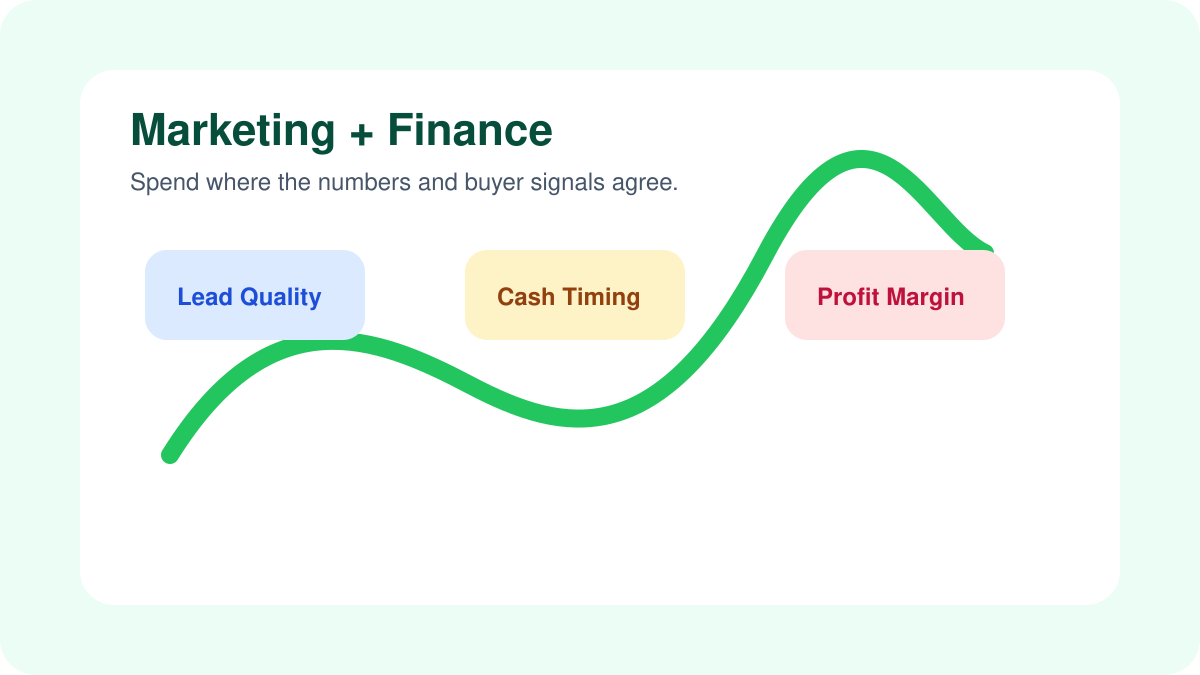
Marketing and finance are often discussed as if they belong to different rooms. Marketing talks about reach, attention, content, clicks and lead volume. Finance talks about margin, cash, pricing, cost and risk. A founder has to live with both. If marketing creates demand that the business cannot profitably serve, growth becomes pressure. If finance blocks every experiment because the return is uncertain, the business becomes cautious and invisible. Healthy growth needs both views at the same table.
Lead volume is not the same as business health
A campaign can create more enquiries and still be a poor decision. The leads may be too small, too urgent, too price-sensitive or too expensive to deliver. The sales team may spend time on calls that never become profitable work. The calendar may become full while the bank account stays tight. This is why lead volume alone is a dangerous measure. Founders need to understand lead quality, conversion rate, average value, delivery cost, payment timing and retention potential.
Finance adds the discipline that marketing sometimes misses. It asks whether the promoted offer deserves more attention. It asks whether the cost of acquisition makes sense. It asks whether the business can deliver the work without creating overtime, rework or customer disappointment. These questions do not slow growth. They protect growth from becoming waste.
Marketing needs financial context to choose better targets
Without financial context, marketing teams often optimize for the easiest numbers to see. They chase traffic, impressions, rankings, email opens or form submissions. Those metrics can be useful, but they are not the final goal. A business may rank for broad topics that attract readers who will never buy. It may generate cheap clicks from people outside the service area. It may produce content that looks busy but does not support the services with the strongest margin. Financial context helps marketing focus on the customers, offers and channels that matter.
- Best customer: who buys profitably and stays satisfied?
- Best offer: which service creates strong value without delivery chaos?
- Best channel: where do qualified buyers discover and trust the business?
- Best next step: what action should the visitor take after reading?
When these questions are answered, marketing becomes sharper. The website can emphasize the right services. Blog posts can answer questions from valuable buyers. Google Ads can use tighter keywords and better landing pages. Local listings can highlight categories that match profitable work. Social proof can be chosen because it supports the commercial direction, not because it is merely available.
Finance needs marketing context to avoid false savings
Finance can also make mistakes when it lacks marketing context. Cutting every uncertain activity may protect cash in the short term while starving the pipeline. A founder may stop content, pause ads, ignore local listings or delay website improvements because the return is not immediate. That caution can be understandable, especially when money is tight, but a business still needs future demand. The question is not whether to spend or not spend. The question is which growth investment has the clearest path to qualified revenue.
Marketing context helps finance distinguish between waste and investment. A campaign with poor tracking may look risky because nobody can see what happened. A content program may look slow because the business is measuring only immediate leads, not the way articles support sales conversations and search authority. A local listing cleanup may look minor until the business realizes inaccurate categories and weak reviews are reducing trust before visitors reach the website. Finance should challenge assumptions, but it should also understand how demand is created.
Build a shared scorecard
The practical solution is a shared scorecard. It does not need to be complicated. Start with a small set of measures that connect demand to money: enquiries by source, qualified enquiries, conversion rate, average value, gross margin, follow-up speed, cost per qualified lead and cash timing. Add notes about lead quality and delivery pressure. This gives the founder a better picture than either a marketing report or a finance report alone.
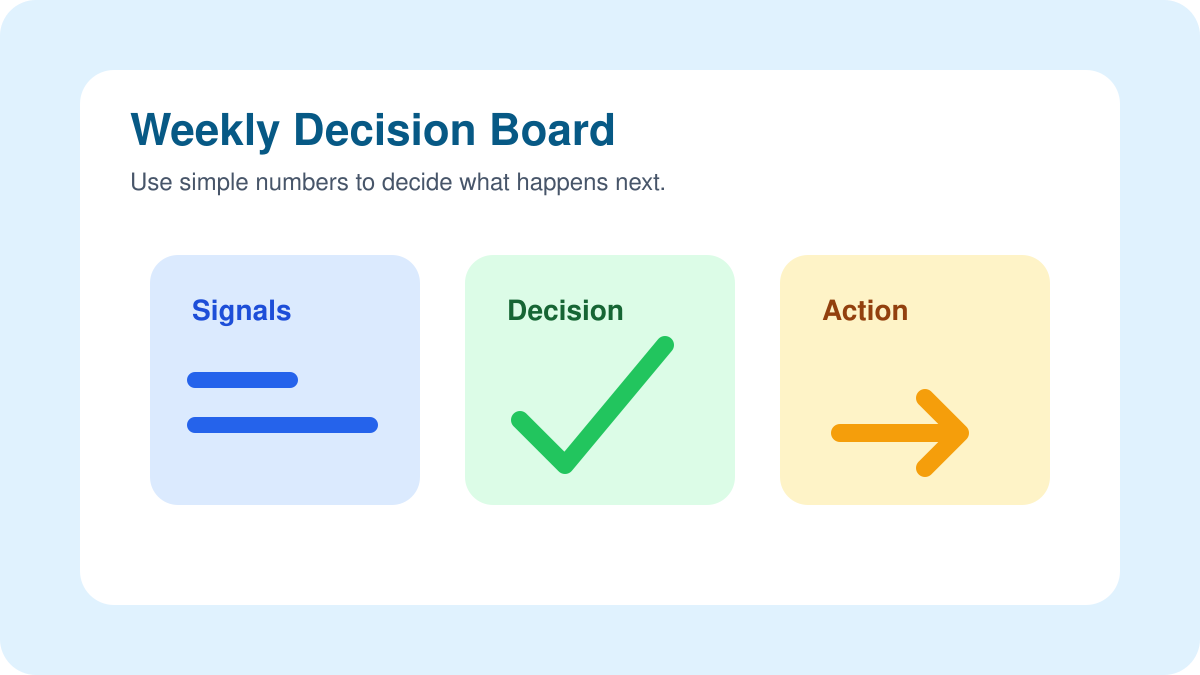
A shared scorecard also improves conversation. Marketing can explain why a channel deserves patience or why an offer needs a better page. Finance can explain where margin pressure is building or why payment terms matter. Sales can explain which leads are wasting time and which questions prospects keep asking. Operations can explain whether the business can deliver more of a particular service. The founder can then make decisions with fewer blind spots.
Use budget rules instead of emotional spending
Many businesses spend emotionally. They increase ad spend when enquiries feel quiet, cut marketing when cash feels tight, buy software when the team feels overloaded and rebuild the website when competitors look better. Budget rules create a calmer approach. For example, a business may decide that Google Ads spend can increase only when conversion tracking is working, landing pages are specific and the cost per qualified lead stays within a defined range. A content budget may be protected when articles support high-value services and improve sales follow-up assets.
Rules do not need to be rigid. They simply create a default decision path. The founder can still override them, but the override becomes intentional. This prevents the business from reacting to every slow week or exciting idea. It also helps agencies, contractors and internal team members understand how recommendations will be judged.
The founder’s job is to connect the conversation
Marketing and finance alignment does not require a large corporate process. It requires a founder to ask integrated questions. What are we trying to sell more of? Who is most likely to buy it? What does it cost to attract them? What does it cost to serve them? How quickly do they pay? What proof do they need? Which channel gives us the best chance of reaching them? Which number will tell us whether the decision worked?
When the business asks those questions consistently, growth becomes more disciplined. Marketing stops chasing attention for its own sake. Finance stops treating every growth activity as a vague expense. The founder gets a clearer view of where to invest, what to improve and when to say no. That is the real value of aligning marketing and finance before scaling.
A simple alignment agenda
A practical alignment meeting can be short. Start with the services or products the business most wants to grow. Review whether those offers have clear pages, proof, pricing logic and follow-up steps. Then look at the previous month’s enquiries and separate them into strong fit, possible fit and poor fit. Ask where each group came from. Finally, compare the marketing source with the likely value and delivery effort of the work. This creates a better conversation than looking at traffic or revenue in isolation.
The output should be a decision, not a spreadsheet. The business may decide to improve a landing page before increasing ad spend, raise the qualification standard before accepting more calls, shift content toward a higher-margin service or pause a channel that creates poor-fit demand. When marketing and finance agree on the decision rule, the founder can act with more confidence.
This rhythm also makes future agency or contractor work easier to manage. External specialists can still bring expertise, but recommendations are judged against the same commercial frame. That keeps the founder in control of growth priorities.